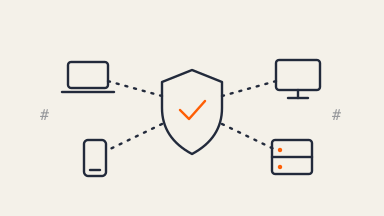
Hospitality companies operate highly distributed environments across hotels, resorts, restaurants, corporate offices, reservation centers, and remote workers. Endpoints include front desk systems, shared workstations, corporate laptops, back-office devices, point-of-sale support systems, tablets, servers, and vendor-managed machines.
A hospitality company engaged our team to transform endpoint security across 5,000 endpoints using modern EDR/XDR capabilities, managed monitoring, and AI-assisted detection. The program helped detect and contain a malware-based attack within 15 minutes with zero data loss.
The Problem
The organization had endpoint security tools in place, but protection was inconsistent across locations. Some devices had outdated agents, some were not reporting properly, and local IT teams managed endpoint issues differently by region.
Challenges included limited visibility into shared workstations, delayed malware investigation, legacy antivirus limitations, too many alerts without clear prioritization, inconsistent endpoint policies, and no centralized response model across regions.
Leadership wanted stronger endpoint protection without disrupting hotel operations.
The Assessment
We began with an endpoint security assessment covering endpoint inventory, EDR coverage, agent health, operating system posture, local administrator rights, remote access exposure, endpoint alert history, and incident response workflows.
AI-assisted analytics helped group endpoints by location, business function, behavior, protection status, and risk. The assessment identified missing telemetry, outdated policies, unnecessary local administrator privileges, remote devices that were not updating consistently, and malware alerts that were being handled manually.
The conclusion was clear: the company needed a centralized endpoint security program supported by AI-enabled detection and managed response.
The Solution
The endpoint transformation program was designed around visibility, prevention, detection, containment, and continuous improvement. The solution used modern endpoint platforms such as Microsoft Defender for Endpoint, CrowdStrike Falcon, or similar EDR/XDR tools depending on the client’s environment.
First, we created a complete endpoint inventory and grouped systems by risk and function: front desk workstations, corporate laptops, executive devices, shared employee terminals, back-office systems, servers, remote workforce devices, and vendor-managed systems.
Next, the EDR platform was deployed across 5,000 endpoints in phases to avoid business disruption. Deployment included agent installation, health validation, malware prevention policies, behavioral detection, ransomware protection, tamper protection, device isolation capability, SIEM integration, and alert routing to the managed SOC.
AI-assisted detection was used to identify suspicious process behavior, correlate alerts across multiple endpoints, detect ransomware-like activity, enrich alerts with threat intelligence, and recommend containment actions.
Managed Response
A 24×7 managed endpoint monitoring process was established. High-severity alerts were validated by analysts, investigated using endpoint telemetry, and escalated using defined response playbooks.
The program included malware investigation, endpoint isolation, suspicious process termination, malicious file quarantine, indicator blocking, threat hunting, executive reporting, and continuous policy tuning.
Clear escalation procedures were created between the managed security team, corporate IT, regional IT, and business stakeholders.
Case Example
During the first phase of the program, an employee opened a malicious attachment that appeared to be a vendor invoice. The file launched a script that attempted to download additional malware from an external location.
The EDR platform detected suspicious document execution, PowerShell activity, attempted payload download, unusual temporary file creation, and connections to a suspicious domain. Similar behavior began appearing on two additional endpoints.
AI-assisted correlation grouped the activity into one malware campaign instead of treating the alerts separately. The managed security team immediately isolated affected endpoints, blocked malicious domains, terminated suspicious processes, quarantined files, searched all 5,000 endpoints for related indicators, and reviewed file access and data movement.
The attack was contained within 15 minutes of confirmed detection. No guest data, payment data, or internal business data was lost.
Outcomes
The program delivered measurable improvements:
- 5,000 endpoints onboarded into modern endpoint security monitoring
- Malware attack detected and contained within 15 minutes
- Zero data loss from the incident
- Improved visibility across hotels, corporate offices, and remote devices
- Faster response to suspicious endpoint behavior
- Reduced dependency on legacy antivirus
- Stronger ransomware protection
- Centralized alerting and incident tracking
- Improved executive confidence and reporting
How We Help
Our team helps hospitality organizations assess, deploy, manage, and optimize endpoint security programs. Services include EDR/XDR deployment, Microsoft Defender for Endpoint support, CrowdStrike Falcon implementation, endpoint policy tuning, ransomware protection, malware investigation, managed detection and response, threat hunting, SIEM integration, and executive reporting.
Contact us today to schedule an Endpoint Security Readiness Assessment and learn how we can help protect your locations, users, systems, and data.